
What is a cobot?
Collaborative robots, also known as cobots, are robots designed to work together with operators in a shared workspace. Unlike traditional industrial robots, which are always placed behind safety fencing, cobots are designed to work safely and directly alongside human operators.
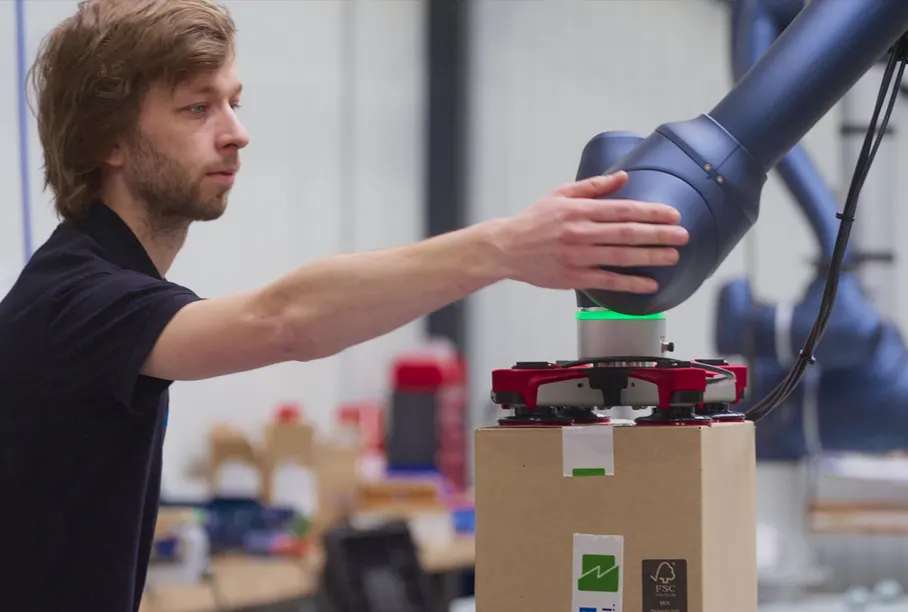
Collaborative robots, also known as cobots, are robots designed to work together with operators in a shared workspace. Unlike traditional industrial robots, which are always placed behind safety fencing, cobots are designed to work safely and directly alongside human operators.
Safety
Cobots come with advanced safety functions and force sensors as standard. When the cobot's path is interrupted by an object or a person, it switches to a safety mode. This limits the force the cobot exerts on its surroundings, so that an operator who gets caught does not sustain injuries.
By adding extra safety sensors, such as safety scanners, cobots can detect the presence of operators and respond to human movements to prevent collisions. With this technology, zones can be set up so that the cobot automatically slows down when an operator is detected nearby. In every cobot project, it is important to always take into account the safety standards described in ISO 10218-1:2025 and ISO 10218-2:2025 – Robotics Safety Requirements. After all, a cobot application can also be declared unsafe because of a poorly executed integration. We always supply a valid CE certificate when delivering our cobot projects.
Flexible deployment
Given the small footprint of a cobot set-up, it can easily be deployed at different locations in a production process or in warehouses. A cobot is usually mounted on a pedestal or on a frame tailored to the project. For palletising applications, we designed our own compact frame. More information is available on the PalCobot palletiser page.
A cobot can just as well be fitted on a mobile base, such as an AMR (Autonomous Mobile Robot). This way, the entire cobot set-up can move autonomously within a production environment to carry out tasks at different locations or to transport goods.
Programming a cobot
Cobots are easy to program and adapt to different tasks and environments. They can be programmed quickly to carry out new tasks or to work with different human operators.
A cobot arm comes with a teach pendant as standard, which lets you set up pick & place movements without real programming. A simple cobot application can be created with the "teach-by-example" principle, in which you show the cobot which path to follow. For more complex applications, we develop custom software for the project.
The impact of cobots on operators
Collaborative robots are designed to work together with people rather than replace them. They can take over tasks that are difficult, dangerous, dirty or repetitive for operators. This frees operators up for tasks that require more creativity or problem-solving skills.
Applications of cobots
Cobots are used in many industries and sectors. They are often deployed as end-of-line cobot palletisers, for example to stack boxes on pallets or to place products in boxes. Cobots are also widely used on assembly lines, for example in metalworking companies and the automotive sector. In the medical sector, cobots carry out dangerous, highly precise or repetitive operations. The possibilities include screwing, welding, sanding, spraying, packaging, machine tending and much more.