
What is the difference between a cobot and an industrial robot?
Automation in manufacturing companies and warehouses is essential. It is the only way to remain competitive in the future. Yet many manufacturers struggle to determine the right automation solution to streamline their processes optimally. Robotics is a crucial factor in creating a pleasant and safe working environment for employees while increasing productivity. Besides improving ergonomics, automation benefits the profitability of manufacturing companies.
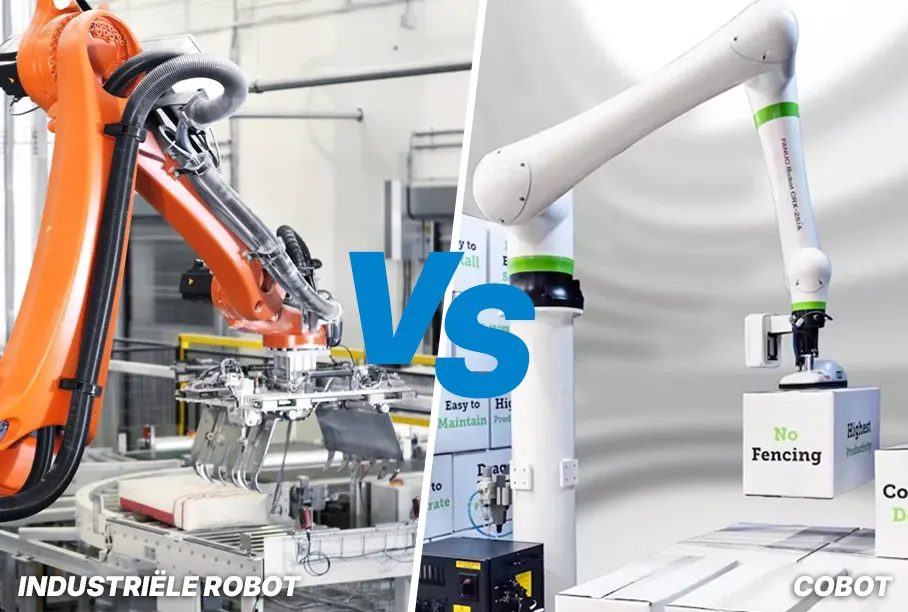
An important consideration when selecting the right robotics solution is the choice between cobots (collaborative robots) and industrial robots. In this blog post, we explain the differences between the two.
Safety systems and footprint
Cobots are designed to work safely and directly with human operators and therefore have advanced safety functions and force sensors. Industrial robots do not have these functions, so stricter protective measures are needed to prevent operators from being injured by the robot's movements. Think of a fully enclosed area with safety fencing, for example.
Working speed and payload
The big difference between cobots and industrial robots lies in the movement speed of the arm and the total payload. Robots are often used to move robust, heavy materials, or lighter materials at very high speeds. These are often complex operations that an operator could not carry out by hand.
Cobots, on the other hand, are used precisely for operations that can be done by hand but are very repetitive. The movement speed of a cobot in its safe mode (collaborative speed) is at most 250 mm/second. This speed can be more than doubled, but then safety scanners, for example, have to be provided. When an operator approaches the cobot, these floor scanners send a signal to the cobot so that its speed is reduced to the collaborative speed again.
Programming
Cobots are easier to program than industrial robots because they have a 'free drive' function. This means operators can move the cobot arm freely and thus position the cobot by hand. Using the standard teach pendant, pick & place movements can easily be taught without writing a single line of code. Industrial robots, by contrast, require specialised knowledge and experience to program movements and operations.
Conclusion
Cobots are often used for tasks that require direct interaction with people, such as assembly, packaging, inspection and collaboration in assembly processes. Industrial robots are often used for automated tasks that require less interaction with people, need very high speeds or simply cannot be done by hand because of weight or reach.
The choice between a cobot and an industrial robot depends on the specific needs of the application and the environment in which it is used.