
Are extra safety measures really needed with a cobot?
It is a question we are asked almost every day: "Are extra safety measures really needed with cobots?" In most cases, our answer is a resounding YES!
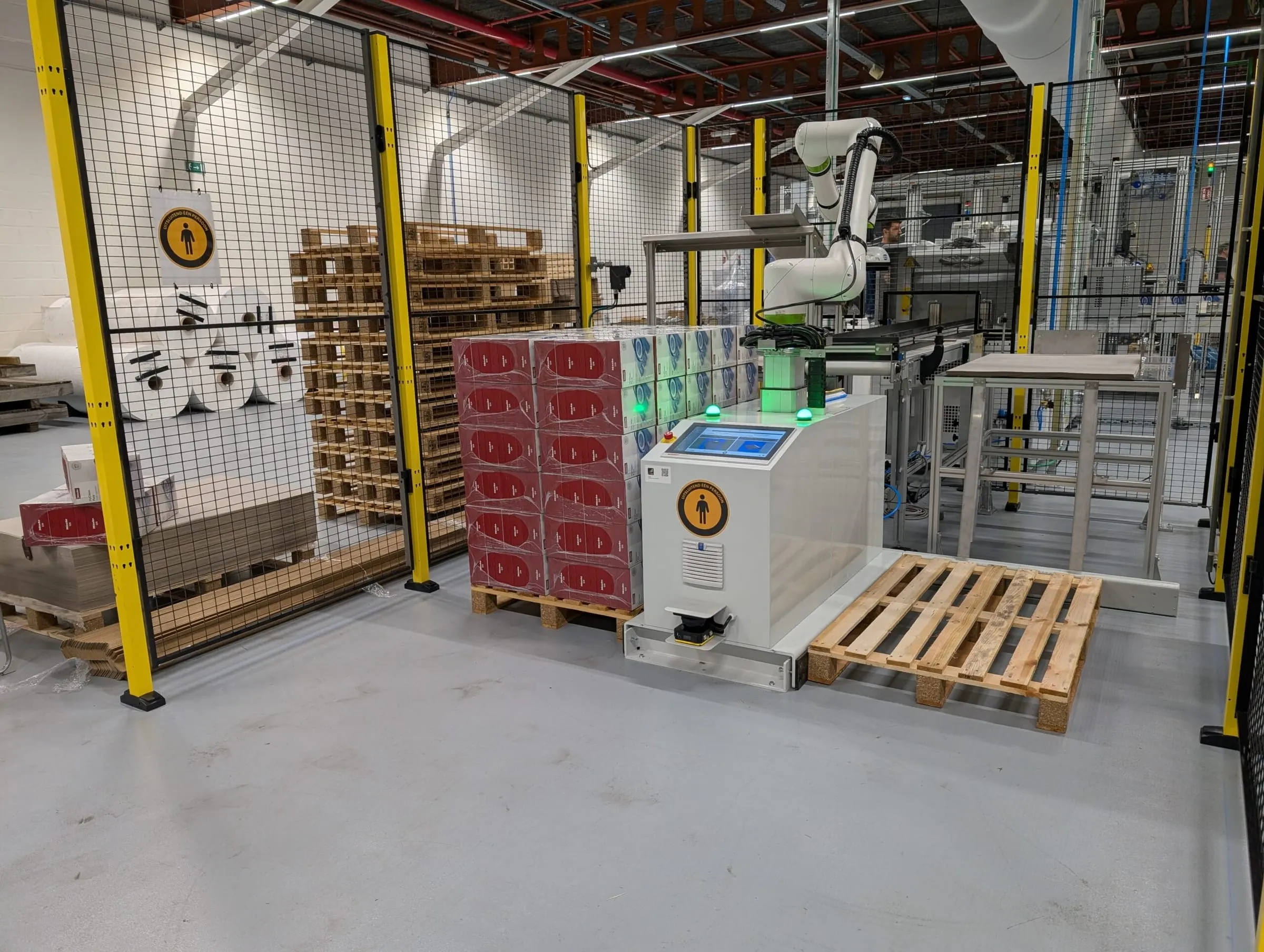
We then regularly get the response: "But why? Aren't cobots specially designed to work safely with and alongside people?"
That is absolutely true. The cobot itself is designed to work collaboratively, but when automating a process, we look at the complete application. Safety does not stop at the robot arm alone. To determine whether a set-up is safe, the whole picture has to be mapped out.
Which factors determine safety?
We provide a CE file for every cobot installation. To guarantee the safety of every installation we integrate, it is important for us to address safety right from the first sales meeting. At the start of every project, we therefore ask the customer and ourselves a series of crucial questions:
- What is the cobot holding: a robot arm may stop safely on resistance, but if it is holding a sharp knife, a hot part or a heavy 20 kg bag, the risk profile changes completely. The product and the gripper largely determine which hazards can arise in the event of unexpected contact.
- Speed and movement: the speed, acceleration and direction of movement of the cobot have a major influence on the possible impact. The position of the movement relative to the operator also plays an important role. Movement at low height and limited speed, for example, involves different risks than a fast movement where the gripper is at an employee's eye level.
- The environment: a safe cobot application takes into account the entire environment in which the robot works. What operations does the cobot carry out? How often do operators come near the installation? Are there other moving elements, such as conveyors or machines? Where could pinch points arise between the cobot, the product and the environment?
- Gripper design: in cobot applications, the gripper often gets less attention than the robot itself, while in practice it is one of the most important safety components. After all, the gripper is the part closest to the operator and the first to make contact in the event of a touch. A safely designed gripper therefore has rounded corners, smooth transitions and as compact a shape as possible. Sharp edges, protruding bolts or pointed structural parts increase the risk of cuts or impact injuries and can considerably increase the impact in the event of unexpected contact.
A safe cobot solution is created by looking at all these elements together. Because no two processes are the same, we carry out a thorough risk analysis at the start of every project. This lets us determine exactly what is needed to make the application 100% safe according to the applicable ISO 10218-1:2025 Robotics Safety Requirements standards.
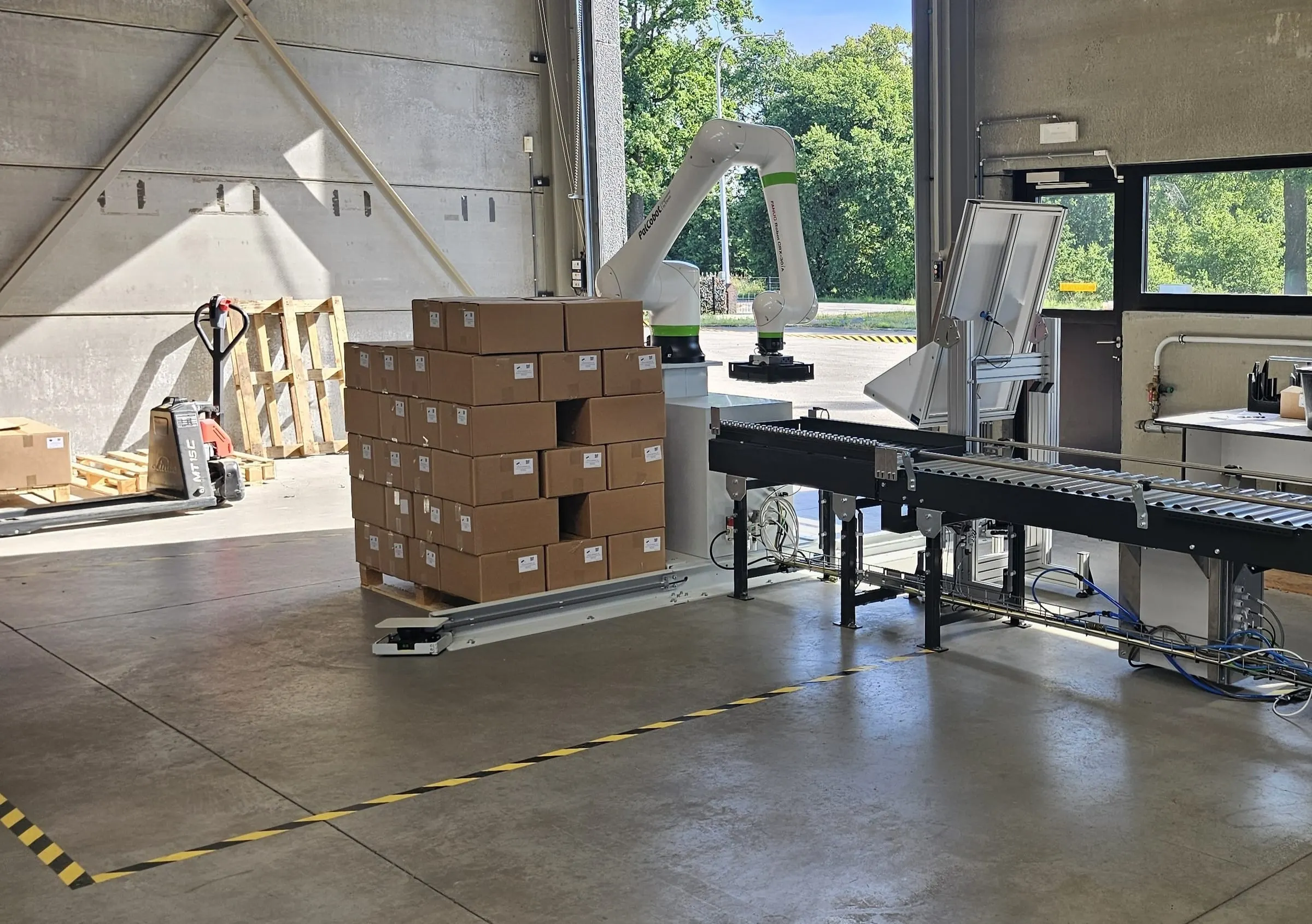
Photo: PalCobot set-up with 3 safety floor scanners.
Optimising the cycle time of the installation
Besides safety, productivity also plays a major role in the choices we make.
If a cobot only runs at collaborative speed, cycle times often increase. And if you only install a safety scanner? Then the cobot will slow down or stop every time an operator walks past. In a busy factory hall, that means a constantly stalling process.
That is why, in practice, we often opt for a hybrid approach: a combination of safety scanners and physical safety fencing.
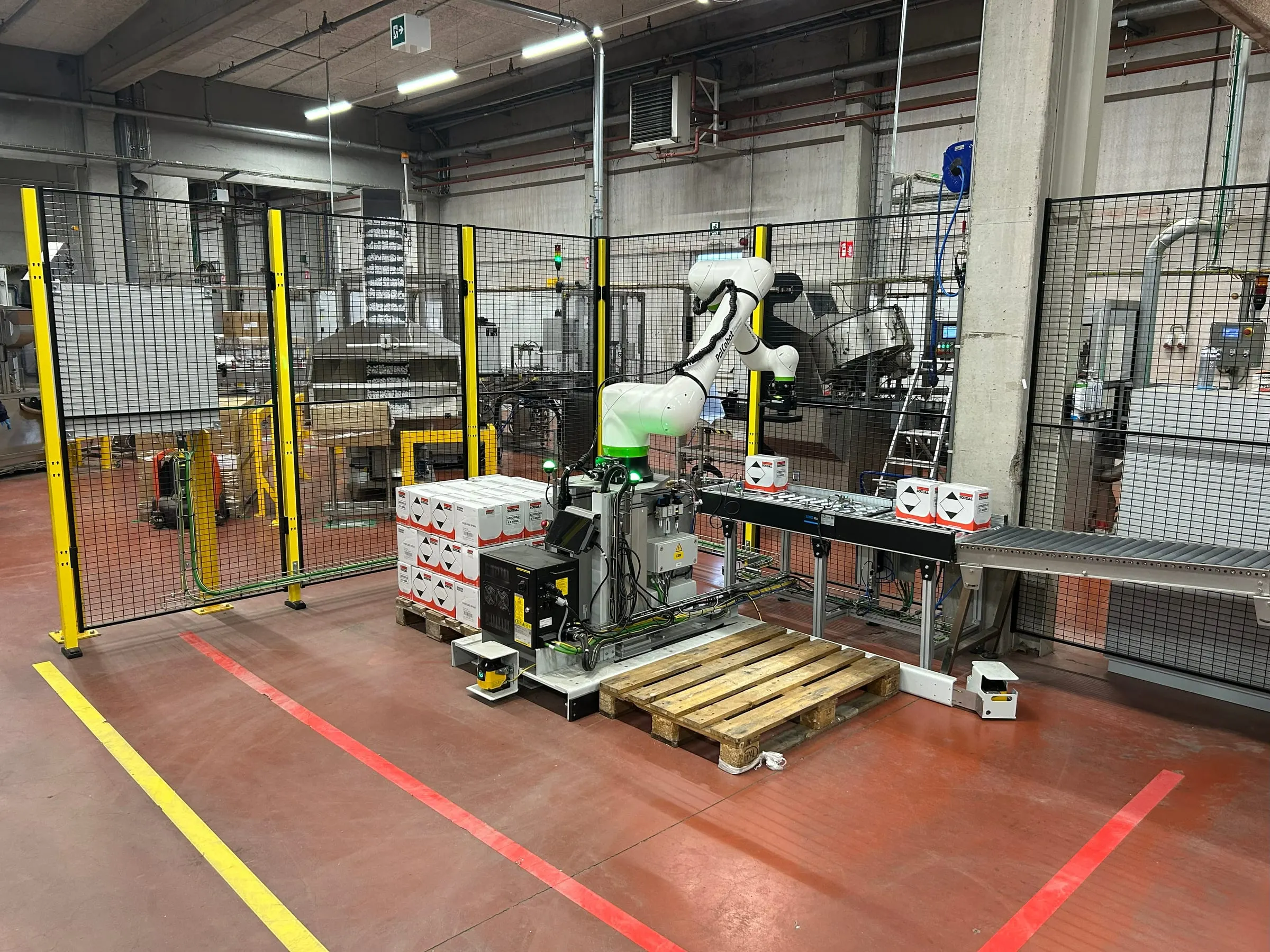
Photo: hybrid PalCobot set-up with 2 safety floor scanners and L-shaped safety fencing.
A practical example
In a PalCobot palletising set-up, this combination offers the best of both worlds:
- Maximum speed: thanks to the protective fencing, the cobot can keep running continuously at maximum production speed on a very small footprint.
- Safety during intervention: only when an operator enters the zone for a pallet change does the scanner automatically switch the cobot back to a reduced, safe collaborative speed.
This way, production never has to stop, the required floor space remains minimal and the safety of your employees is guaranteed.
Conclusion
A cobot is collaborative, but a cobot application only becomes collaborative when the entire process is set up safely. With a well-thought-out risk analysis and the right safety provisions, you get the maximum return from your automation without compromising on safety.